





Industry · Shelving & Storage

A shelving system is a grammar, not a product.

Modules, widths, depths, finishes and the rules that say which of them go together. The catalogue cannot list the outcomes, because there are more outcomes than there are customers.

Why shelving breaks a normal catalogue

You sell combinations. Your catalogue sells parts.

A buyer wants a wall two-and-a-half metres wide with two closed modules and oak shelves. Your catalogue has photos of three showroom builds and a table of module codes.

So the conversation moves to email, someone sketches it, and a sale that could have closed itself takes two weeks and a salesperson.

1,000,000+
buildable combinations

Every one of them renders from the same module set. Adding a finish adds a material, not a photoshoot.

What changes for you

From module codes to a wall the buyer assembles.

The rules live in the configurator, not in someone's head.

Maximum spans, which modules stack, what needs wall fixing. A buyer cannot build something you would have to phone them about.
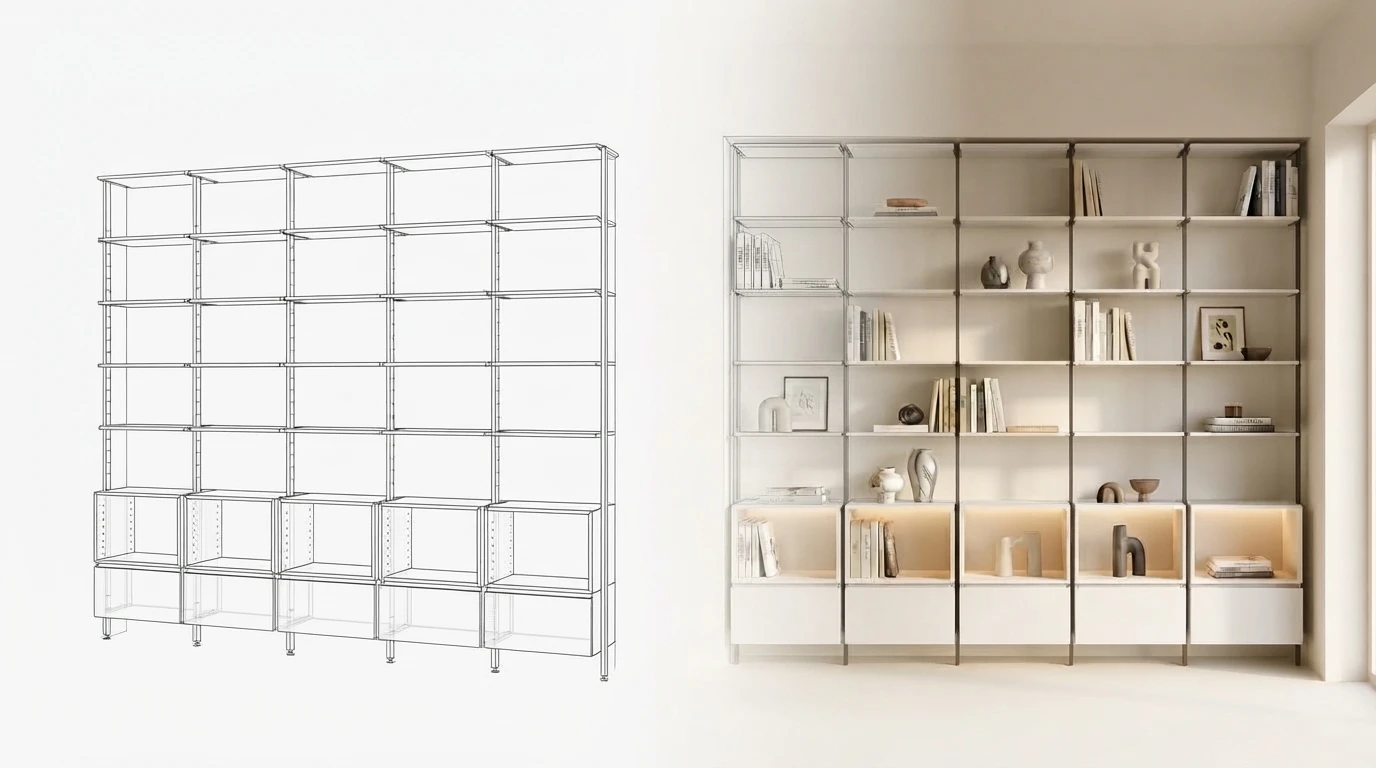
The same shelving wall twice: on the left the parametric drawing with every module and shelf position, on the right the render it produces

Every build has a picture and a price.

Not a render queue and a quote request. The buyer sees the wall they described, with the total, while they are still interested.
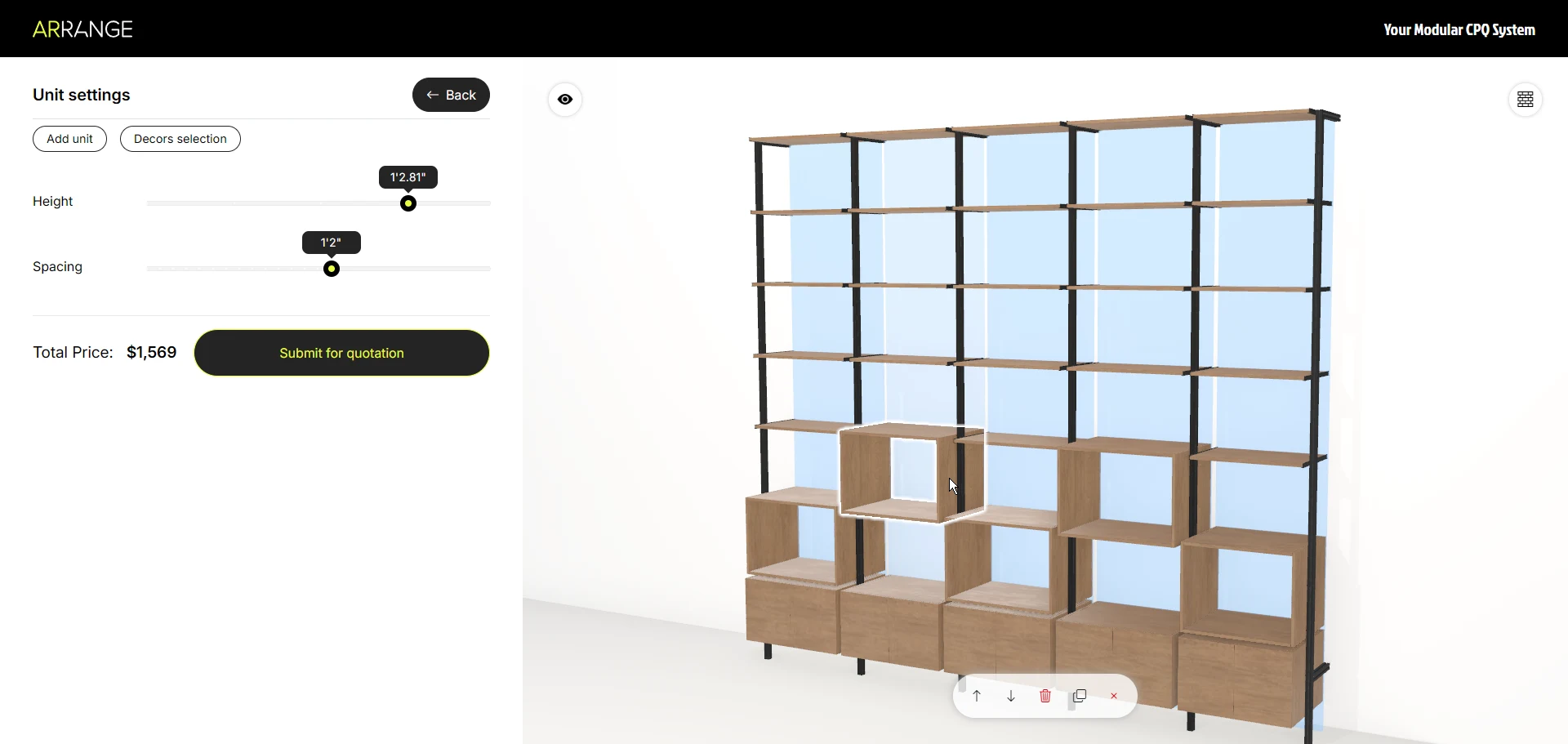
yourshelving.com/build
The configurator: modules on a wall, height and spacing sliders, a running total and a quotation button

The order arrives as a parts list, not a drawing.

What the buyer configured is what production receives: module by module, finish by finish, with nothing re-typed on the way.
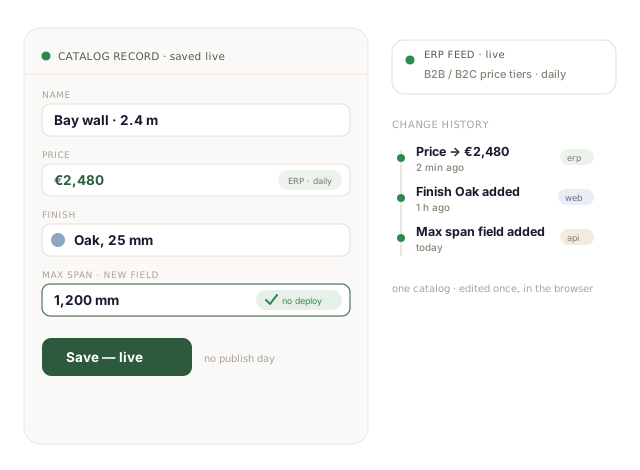
A shelving configuration resolved into a catalogue record: span, finish and price
What makes shelving different

The dimensions are the product.

A sofa comes in sizes. A shelving system comes in whatever fits the wall, which is why it cannot be sold from a fixed catalogue of finished goods.

Parametric, not preset

Height, width, bay count and shelf pitch adjust to the wall, and the model rebuilds as they move rather than snapping to the nearest catalogue item.

A real material library

Over 2,500 decors from the usual board producers, plus full RAL and HEX, so a specified colour is a value rather than an approximation.

Priced as it is drawn

Every dimension change moves the price with it. A quote for a bespoke run stops being a spreadsheet exercise.

Retail display too

The same engine covers shop fit-out: bay systems, gondolas and wall runs, where the drawing has to be right before anything is cut.

Saved and shared

A configuration is a link. Customers save it, email it, and come back to it, and your team can open exactly what they saw.

Straight to the cart

Integrated with the storefront, the configured run is added and bought without a quotation round trip.

FAQ

Questions shelving makers actually ask.

Our system has rules a website cannot possibly know.
It can, because the rules are finite. Spans, load, which modules take doors, what must be anchored: they go in once and then hold on every configuration a buyer tries.
Buyers will design something we cannot build.
Not if the rules are in the configurator. An invalid build is not something the buyer has to be told about afterwards; it is something they never manage to make.
We already have a CAD model of every module.
Good: that is the expensive part done. Modules become the model set, and configurations render from them.
Can it price the build too?
Yes, if your pricing is rule-based. The configurator resolves the parts list; the price follows the same rules your quoting does.
Our shelving is made to measure. Does a configurator even apply?
That is precisely where it applies. The configurator is parametric, height, width, bay count and shelf pitch are inputs, not a list of finished sizes, so the thing being priced is the run the customer actually needs.
How many finishes can it carry?
Over 2,500 decors from the usual board producers, with full RAL and HEX on top, and others added on request. A specified colour stays a specified colour rather than becoming 'the closest we photographed'.
Can a customer come back to a design later?
Yes. A configuration is a link they can save, email and reopen, and your team can open the same one, which removes most of the back-and-forth about which version was being discussed.
Does this work for retail display rather than domestic shelving?
It is the same problem: bays, runs and fixings that have to fit a specific space and be right before anything is cut. Shop fit-out is one of the clearest cases for configuring rather than cataloguing.

Let buyers build the wall they want

Send us your module set and the rules. You get a configurator that only ever produces builds you can actually manufacture.

1Mvariants from one source
Same dayprice changes live in the shop
No-codeconfigurators the client runs
No demo booking, no sales sequence. We reply by email and take it from there.