
Brands ask us this at the start of almost every project: do we need a 3D configurator, or is a set of variant images enough?
They are not competing answers. They solve different problems, and the deciding question is not budget or ambition. It is whether the shape of your product changes when the buyer chooses.
The short version
- If the buyer’s choices change the structure, you need a configurator. A corner sofa that grows a chaise, a wardrobe that gains a section, an outdoor kitchen laid out module by module.
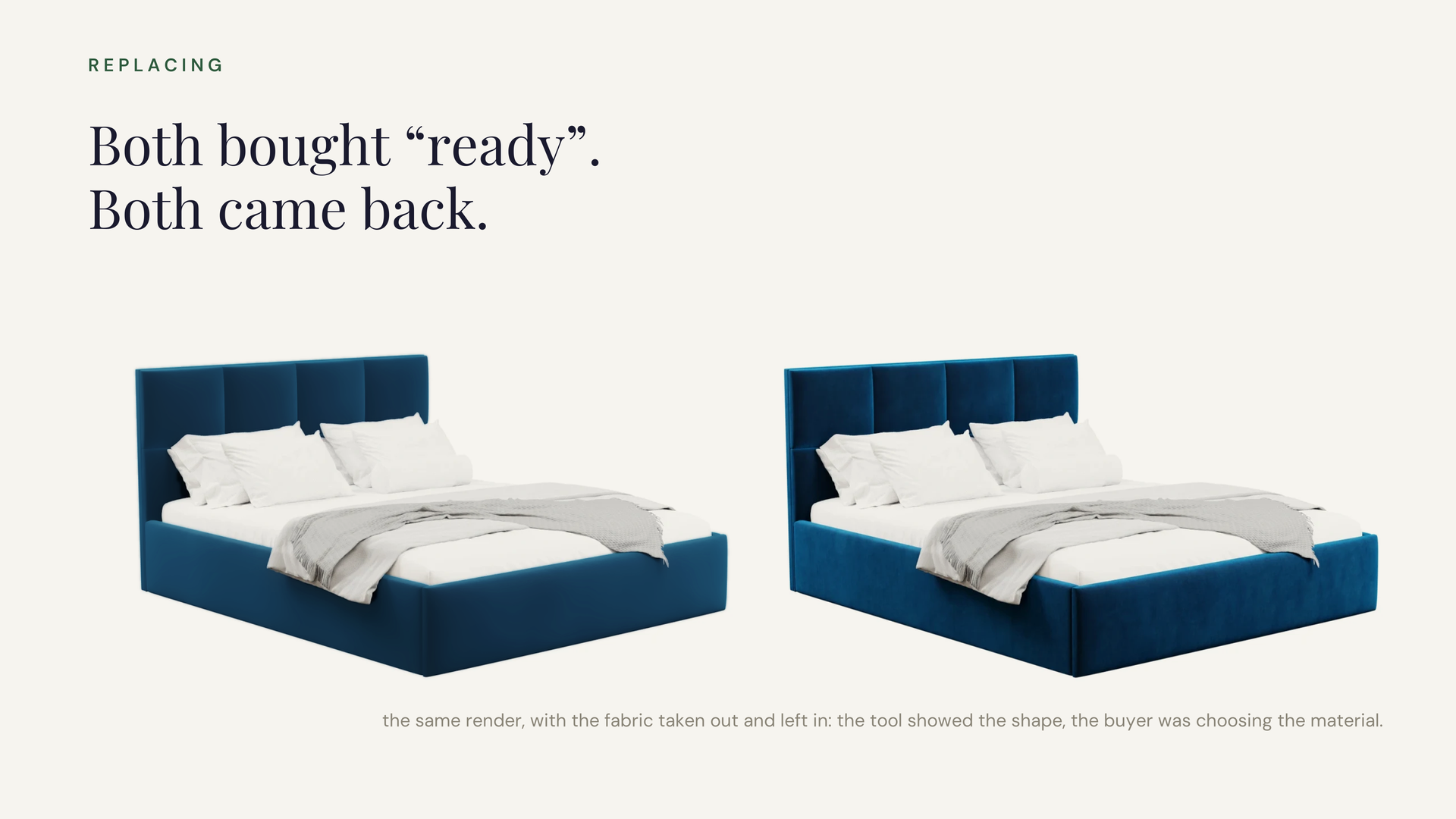
- If the buyer’s choices change the finish, you need variant visuals. The same bed in 542 fabrics, the same sideboard in eight woods, the same chair with four leg options.
- Most catalogues contain both kinds of product, so most brands end up running both.
What a configurator is for
A configurator assembles the product in front of the buyer and prices it as it goes. That is its real value: not the rotation, the build. It belongs where the product is a system rather than an object.
It earns its keep when:
- modules combine in ways a photograph cannot anticipate;
- the price depends on what was chosen, so the quote has to follow the build;
- someone is standing beside the buyer, in a showroom, working through options.
Paradise Grills is the clearest case we have. Their outdoor kitchens are configured on the floor, and the same build feeds the order: the showroom close went from over 30 minutes of paper to under 5 minutes on an iPad, and the POS has processed 12,000+ orders since April 2024.
The cost of a configurator is not the licence. It is the model discipline: every module has to be built to snap to every other module, and every rule has to be written down somewhere a salesperson cannot break by accident.
What variant visuals are for
Variant visuals are the opposite trade. Every combination is rendered ahead of time, so the product page shows a photograph of the exact piece the buyer picked, and nothing renders in the browser.
They belong where the shape is settled and the choice is the surface. MyBed.pl sells beds in 520 fabrics, around 550 today: no studio could photograph that catalogue, and no buyer wants to rotate a bed. They want to see their fabric on it. We rendered 2.2 million product visuals from parametric models, and each one is served through Cloudflare in about half a second, like any other image on the page.
That is the part brands underestimate. A prerendered visual is not a compromised configurator. On a product page it is the better artefact: it loads at page speed, it is indexable, it goes in an email, a PDF, a marketplace feed and a print catalogue, and it looks the same on a five year old phone as on a workstation.
Where they differ in practice
| Configurator | Variant visuals | |
|---|---|---|
| The buyer’s job | Build the product | Recognise the product they want |
| Changes | Structure, size, layout, and finish | Finish, fabric, size within one shape |
| On the page | A live 3D scene | An ordinary image |
| Where it belongs | Showroom, late in the journey, complex systems | Product page, catalogue, feeds, email |
| Production cost | Modelling and rules per system | One model, then rendering per variant |
| What it produces | A priced, ordered build | A library of images every channel can use |
The mistake we see most
A configurator put at the top of the funnel, where a buyer who has not decided anything is asked to assemble a sofa. It does not sell. It filters, and it filters out the people you paid to bring in.
The same brand’s product pages then show one grey photograph and a line of colour dots, which is the point where the buyer who wanted green leaves. That is exactly the wrong way round: the catalogue needed variant visuals, and the configurator belonged at the end, on the showroom floor or at the last step online.
How the two work together
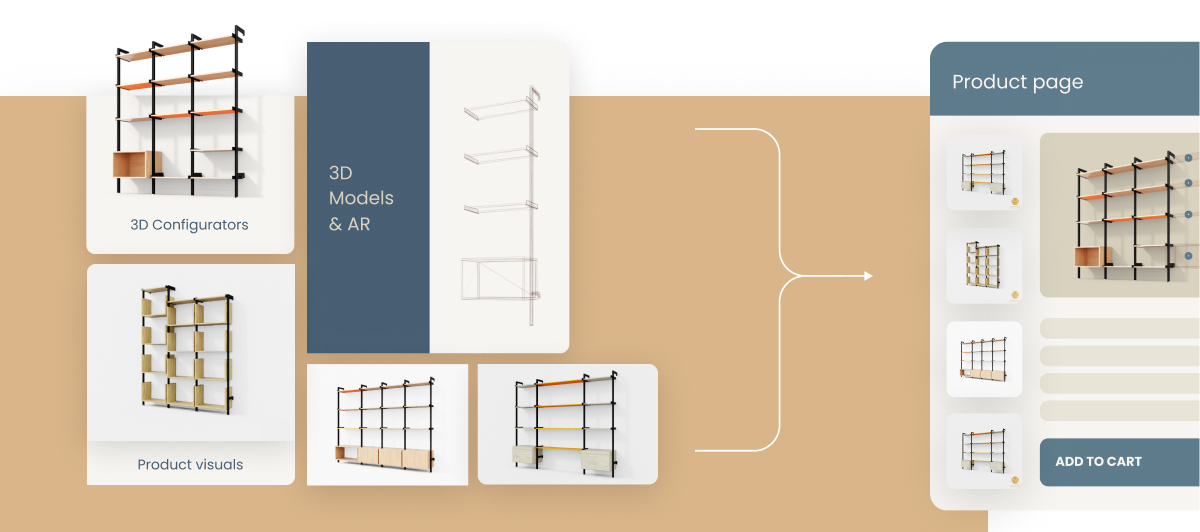
They share one thing, and it is the thing that makes the pair worth building: the same 3D models and the same product record.
Once a model exists, it can render the variant library and drive the configurator. Once the record exists in Content Hub, the storefront, the configurator, the quote and every market read the same colours, prices and rules. Without that, a brand ends up with two versions of the truth, and they drift within a season.
A workable order of building, in our experience:
- Model the range properly, once.
- Render the variants, because the product page is where the money is and it needs pictures now.
- Add the configurator where the product is genuinely a system, and let it reuse the same models.
- Keep one record behind both.
So which one does your catalogue need?
Ask what the buyer is choosing. If they are choosing a shape, build the configurator. If they are choosing a finish, render the variants. If your range does both, build in that order, and keep one source of truth behind them.
If you want the second opinion on a specific range, tell us what you sell and how it varies, and we will say plainly which half you need.