
The question that comes up at every trade fair
At a furniture fair in Poland, a colleague asked the owner of a hardwood furniture company whether they had a configurator. He looked puzzled. “What’s that?”
That is a fair question, and this post answers it plainly: what a product configurator is, how it works, the kinds that exist, and where to see one in action.
What is a product configurator
A product configurator is a tool that lets a buyer build their own version of a product and see it before they order. It has three parts working together:
- A visual layer. A 3D model or a set of pre-rendered images that updates as the buyer changes an option.
- Rules. What combinations are actually valid, so a buyer cannot pick an oak top with a base that does not come in oak.
- Pricing and order. The choices feed a price and, when it is wired up, a real order that reaches production.
A configurator is not a gallery. It does not replace a salesperson’s judgement, it gives the buyer a way to explore options on their own before that conversation happens, and it gives the salesperson a tool to build the same configuration together in the showroom.
How a product configurator works
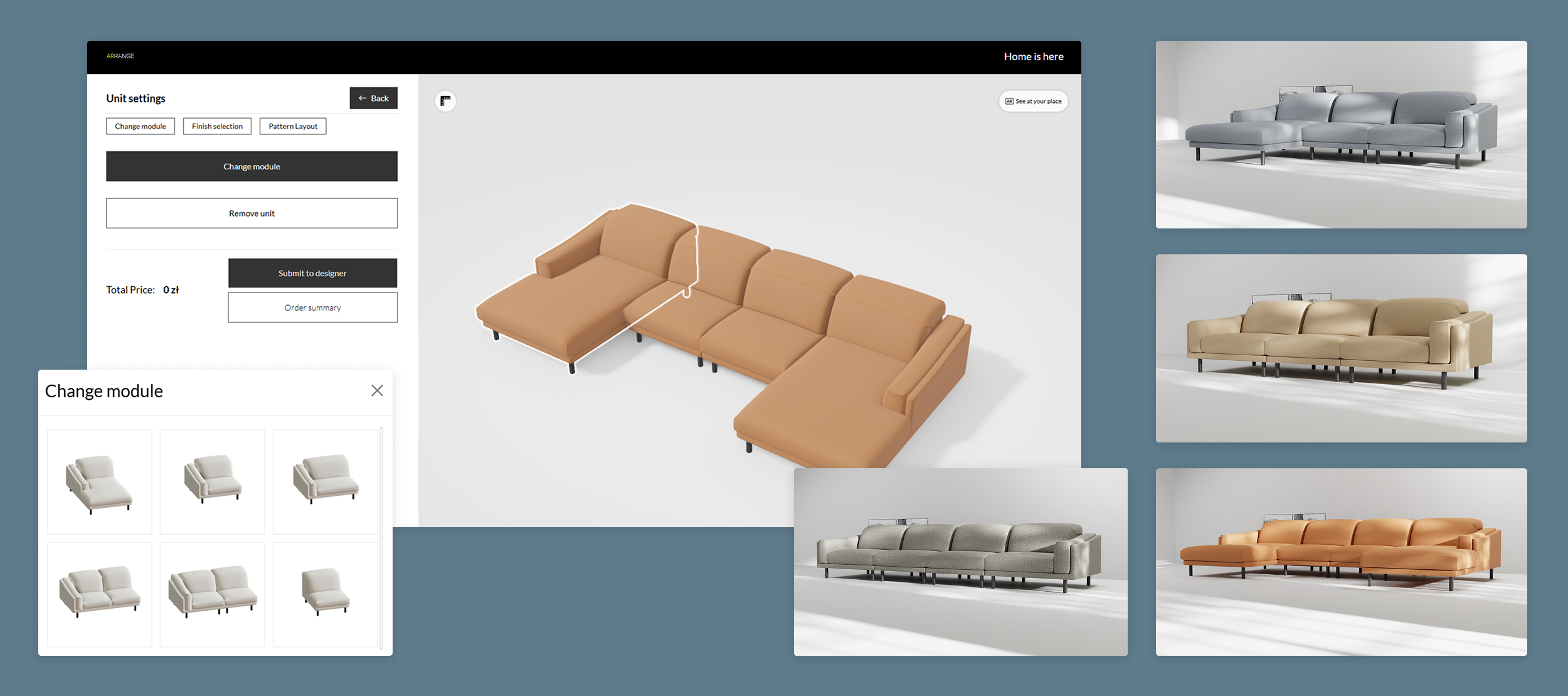
- The buyer picks a base product. A sofa, a bed, a cabinet system.
- The configurator presents the options. Size, upholstery, wood finish, leg style, whatever the catalogue actually offers.
- The visual updates as they choose. Each selection changes what they see, in real time.
- Price and availability update with it. The buyer always knows what the current configuration costs.
- They order or save it. Straight into a cart, or handed to a salesperson to finish in the showroom.
The types of product configurator
The first choice is not 3D versus something else. It is where the sale happens and who is holding the mouse.
- Online configurators run unattended on a product page. The buyer explores alone, at their own pace, usually before they have decided to buy.
- Showroom configurators are built by a salesperson with the customer standing next to them, often on a screen embedded in the counter or the till. The salesperson drives, the customer decides.
- Dealer configurators quote for a reseller network rather than an end customer, with pricing rules the dealer never sees adjusted underneath.
Within any of those, the way the product is drawn varies:
- Real-time 3D renders the model live in the browser as options change. Best where the number of possible combinations is too large to pre-render.
- Pre-rendered variants show a photorealistic image for each valid combination, generated in advance. Faster to load, and the right choice when the combination count is large but finite.
- Parametric configurators let dimensions themselves change, not just finish, which matters for made-to-measure furniture. See our explainer on parametric configurators for how that differs from picking from a fixed list.
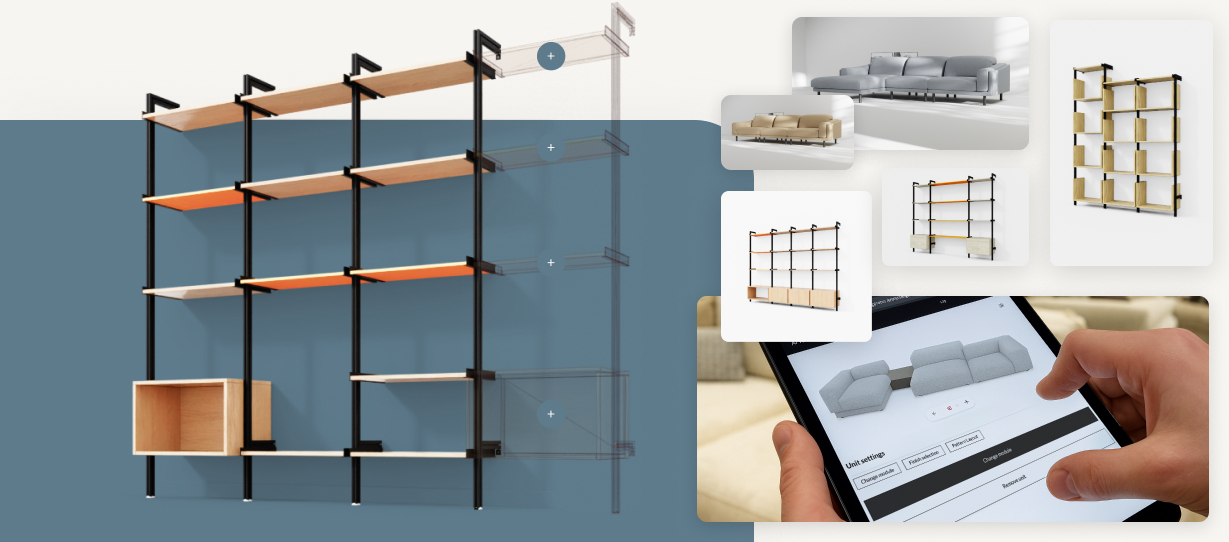
- Modular configurators let a buyer combine pre-designed modules, such as picking the size, material and finish of each shelf in a shelving system separately.
Examples from furniture brands
Paradise Grills runs a showroom configurator for custom outdoor kitchen islands: the salesperson builds the island with the customer on an iPad, and what used to take thirty minutes on paper now takes five.
Bathroom brand BLU runs an online modular configurator that walks a buyer through a bathroom set: countertop type and width, sink, cabinet height, then any arrangement of modular cabinets, colours and handles, with a running total as they go.
What it changes for the business
MyBed.pl rendered every fabric finish across their bed catalogue and built a configurator for each of 120 bed models. Together with the visuals, that lifted online store conversion by around 15%. Paradise Grills cut the time to close a custom order from around thirty minutes of paper forms to about five minutes on the salesperson’s tablet.
When you do not need one
Not every catalogue benefits. A configurator earns its cost when the product follows a repeatable structure with genuinely different options, and when the sales conversation involves real back-and-forth over combinations and price. It earns nothing when every piece is a true one-off with no reusable base, or when the range is small enough that a handful of photos already answers every question a buyer has. If you are not sure which side you are on, we cover the checks to run first.
What it costs, and what it takes to set up
Cost depends on how many models, fabrics and views you need covered, not on the configurator software itself. We break down the arithmetic in Costs. Getting one live depends more on what you already have ready: 3D models, fabric samples, product data. See what implementation actually takes.